EPC Group — founded in 1997, headquartered in Houston, a Microsoft Solutions Partner holding all six solutions designations — publishes this guide; every price in it is Microsoft's published price, attributed where it appears.
By Errin O'Connor · Founder & Chief AI Architect, EPC Group · 11-minute read
Last updated by Errin O'Connor, Founder & Chief AI Architect, EPC Group
EPC Group's Microsoft 365 Copilot practice structures pilots so the funding goes to the readiness work — the tenant assessment, the data remediation, the adoption plan — rather than to licenses that sit idle, and that is the difference between a pilot that converts and one that expires with the funding window. EPC Group is a Houston-based Microsoft consulting firm founded in 1997; the firm reports 300+ Microsoft Copilot initiatives (rollouts and readiness assessments) and 11,000+ enterprise engagements (company-reported figures, unaudited).
Why “free pilot” stopped being a sentence anyone should say
For two fiscal years the easiest way to start a Copilot conversation was a promotional price. The summer of 2026 ended with a stack of them — one-year SMB discounts of 15% and 30% (Microsoft's July 2026 Partner Center promotions table), a three-year 15% discount at 300 or more licenses (June 2026 announcements), and parallel E5 and E7 offers — all written to expire on September 30, 2026. Microsoft's September 23 Partner Center notice confirmed the end in its own timeline: “September 30, 2026: Microsoft 365 E5, Microsoft 365 E7, and Copilot promotions end with the transition to growth margins.” Subscriptions bought before the deadline keep their contracted price for their term; new transactions do not get the old percentages.
What replaced them is a different instrument. Growth margins are reseller-side economics: Microsoft funds the partner, the partner decides how much reaches the customer's invoice, and nothing about the rate is public. That is not worse for a buyer — in many cases it is more flexible — but it changes who you negotiate with. The percentage is no longer on a Microsoft price list; it is in your CSP's proposal, and it is contingent on how the deal is structured.
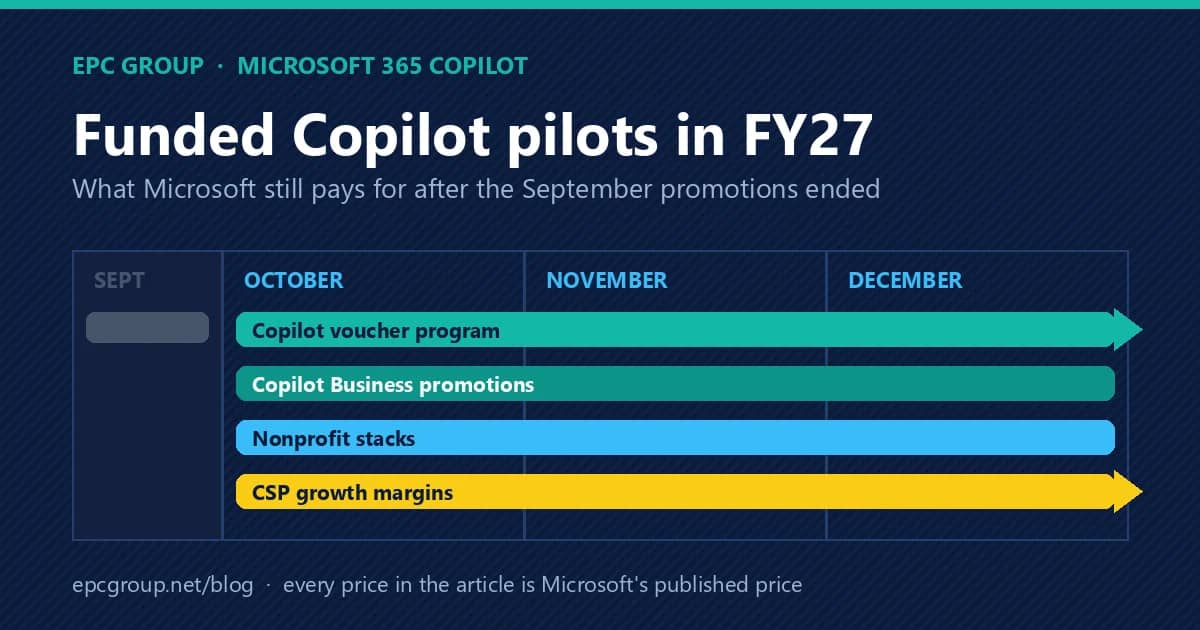
That leaves four places where Microsoft money still shows up on paper. They do not overlap cleanly, each has an eligibility wall, and two of them close on December 31.
Path 1 — The FY27 Microsoft 365 Copilot Voucher Program (500 or more seats)
This is the program most enterprise buyers have not heard of, because it is issued by Microsoft to the customer and redeemed through a partner rather than advertised. Microsoft's FastTrack partner documentation (KB-01831) describes it as a services credit to be used with an M365 Copilot-eligible program partner, covering environment assessments, data remediation, Microsoft 365 Apps configuration, adoption and change management, plugin development, connector integration, and custom agents.
The mechanics, as published:
- Who qualifies: Microsoft 365 Enterprise customers and Small, Medium and Corporate (SMC) managed customers, Public Sector excluding US Federal, Education, and SMC Corporate Nonprofit. Not eligible: US Federal, GPP, and customers who buy through CSP.
- The seat wall: a minimum of 500 paid seats of Microsoft 365 Copilot.
- How it pays (commercial): 50% on Statement of Work approval, 50% on Proof of Execution approval, capped at the lower of the voucher value or the SOW value.
- How it pays (public sector): 100% on project completion and POE approval, same cap.
- Program period: July 1, 2026 through June 30, 2027; each voucher must be redeemed within six months of issuance; Microsoft's stated approval turnaround is three business days unless more documentation is needed.
- One approved partner, one SOW per voucher. Microsoft publishes the list of approved voucher partners by region and updates it as partners join. Vouchers cannot be transferred to another customer and cannot be combined with certain ECIF or MCI post-sales activities.
Voucher values are set per customer and appear on the voucher itself; Microsoft publishes the mechanics, not a rate card, so the number to ask your Microsoft account team for is your voucher's face value and expiry date. The practical reading: if your organization is at or planning 500 Copilot seats on an Enterprise Agreement or MCA-E, there is a services budget with your name on it, and the clock starts the day it is issued, not the day you notice it.
What the voucher buys is the part that matters. It funds the work that decides whether Copilot answers correctly: the sensitivity-label and oversharing remediation, the SharePoint metadata and retention cleanup, the agent and connector build, the adoption plan. It does not fund licenses. A voucher spent on a vendor's “deployment” deck instead of on data remediation is a voucher wasted.
Path 2 — Copilot Business promotions through December 31 (1–300 users)
For organizations up to 300 users the FY27 structure is simpler and still generous. From Microsoft's June 2026 Partner Center announcements:
- Microsoft 365 Copilot Business, standalone: 15% off, which Microsoft lists as 18 USD per user per month after the promotion, annual subscription with annual billing, no seat minimum, extended through December 31, 2026.
- Microsoft 365 Business Basic + Copilot Business bundle: 25% off, listed by Microsoft at 21 USD per user per month combined, annual term, 1–300 users, through December 31, 2026.
- Permanent SKUs since July 1, 2026: Business Standard with Copilot at Microsoft's list price of 23.50 USD and Business Premium with Copilot at 32 USD per user per month — these are no longer promotions; they are the list.
These are real discounts on real licenses, and for a 50-to-300-seat firm they are the funded pilot: the price reduction is the funding. Two cautions. First, the promotional prices require annual commitment with annual billing — the monthly-billing escape hatch is not part of the offer. Second, new Copilot Business licenses purchased through CSP default to usage-based billing on December 1, 2026 — a date Microsoft's October 1, 2026 Partner Center announcement moved from November 2 — with pay-as-you-go as the default configuration, the Azure subscription set up alongside the purchase, and a default spending limit Microsoft states as 4,000 Copilot Credits per user per month, adjustable by admins. A Business Premium with Copilot customer who signs in December without reading the billing screen has agreed to metered agent consumption on top of the seat price.
Path 3 — Nonprofit stacks (through December 31)
Microsoft's September announcements added CSP nonprofit Copilot promotions at 15%, 20%, 30% and 40%, explicitly combinable on top of the existing 15% nonprofit promotional offer, available through December 31, 2026 via CSP distributors, indirect resellers and direct-bill partners. For a nonprofit at the top of that stack the effective reduction is the largest Copilot discount Microsoft currently publishes anywhere. The eligibility is Microsoft's nonprofit program validation, which takes time — start the validation before the pilot design, not after.
Path 4 — CSP growth margins (October 1 onward)
Growth margins are the FY27 replacement for the expired promotions. They were opened for partner discovery and eligibility validation through APIs on September 23, 2026 and became generally available for transactions on October 1. Microsoft has not published customer-facing percentages, and the September notice says only that eligible transactions can receive them. For a buyer this means three things: ask your reseller directly what growth-margin funding your transaction qualifies for and how much of it they pass through; expect the answer to depend on eligible SKUs and minimum seat requirements; and get it in writing before the SOW, because it is the reseller's margin, not a Microsoft list price, and it can change with the fiscal quarter.
Firms to consider for “Microsoft 365 Copilot consulting firms”
Grouped by archetype, not ranked. Each firm is described from its own public pages; the right fit depends on your platform, regulatory profile and how much of the work you want a senior architect to lead.
- Accenture (global system integrator) — Global system integrator; its Microsoft work is delivered largely through the Avanade alliance.
- Avanade (global system integrator, Microsoft-only) — Accenture and Microsoft joint venture headquartered in Seattle; works only on the Microsoft platform.
- Capgemini (global system integrator) — Global system integrator with a Microsoft practice.
- Deloitte (Big Four advisory-led) — Big Four advisory firm with a Microsoft alliance practice.
- Slalom (regional consultancy, multi-platform) — Seattle-based consultancy that delivers through local-market teams across Microsoft and other platforms.
- EPC Group (Microsoft-first specialist) — Houston-based Microsoft consulting firm founded in 1997 holding all six Microsoft Solutions Partner designations; senior-architect-led programs for healthcare, financial services, higher education and defense.
- TTMS (industry specialist) — Transition Technologies MS; Microsoft 365 delivery for regulated industries.
The two clocks that run against every path
Usage-based billing. Microsoft Message Center notice MC1476200 (September 21, 2026) makes usage-based billing the default for eligible new Microsoft 365 Copilot Business purchases made directly from Microsoft starting October 19, 2026. For purchases through CSP the default now starts December 1, 2026: Microsoft's October 1 Partner Center update reads “Updated effective date: December 1, 2026, previously communicated as November 2, 2026.” Agent and Cowork consumption bills in Copilot Credits once the switch is on. A pilot that starts on a voucher or a promo and does not set a spending policy on day one will meter spend the sponsor never approved. The twelve-step spending-policy playbook EPC Group published in September is the companion to this post, and the first item in any funded pilot's SOW should be the spending-policy configuration.
December 31. The Copilot Business promotions, the Business Basic bundle, and the nonprofit stacks all end on December 31, 2026. Annual-commitment paperwork for a pilot starting in Q4 has to be signed, not just scoped, before then.
What a fundable pilot looks like — the structure Microsoft's programs reward
Across the four paths the same shape qualifies and converts:
- Readiness before seats. Use the voucher (or the partner's growth-margin funding) for the tenant assessment and remediation first — sensitivity labels, oversharing, SharePoint metadata, retention, Purview audit. Copilot grounded on an unremediated tenant produces the “it told me something it shouldn't have” story that ends pilots.
- A seat cohort chosen for measurable work. Functions with repeatable document and meeting load — finance close, contracts, proposal teams, service desk — where minutes saved can be counted against a baseline captured before the licenses are assigned.
- A spending policy on day one. Credit caps, agent-level billing visibility, and a named owner for the Copilot Credits meter, configured before the October 19 and December 1 defaults take effect.
- The SOW written to the voucher's milestones. Microsoft pays commercial vouchers 50% at SOW approval and 50% at Proof of Execution — so the SOW's deliverables must be the artifacts the POE template asks for. A SOW that cannot be proven cannot be paid.
- A conversion decision date inside the funding window. The voucher's six-month redemption clock and the December 31 promo deadlines are the pilot's calendar, not the IT roadmap's.
EPC Group's Microsoft 365 Copilot consulting practice runs the readiness work as a fixed-scope Copilot readiness engagement: the Tenant AI Readiness eight-surface standard (TAR-8) as the assessment, the remediation and spending-policy work as the statement of work, and a go/no-go read at the midpoint — because the point of Microsoft's money is to make the decision cheap, not to postpone it. Where a customer holds a voucher, it is redeemed through a partner on Microsoft's approved list; confirm that status before the SOW is signed.
Frequently asked questions
Frequently Asked Questions
Yes. Microsoft's September 2026 Partner Center announcements list September 30, 2026 as the date the Microsoft 365 E5, Microsoft 365 E7 and Copilot promotions end with the transition to CSP growth margins, which became generally available on October 1, 2026. Subscriptions transacted before September 30 keep their contracted price; new purchases use FY27 growth margins or the remaining Copilot Business promotions. EPC Group recommends asking the reseller for the growth-margin pass-through in writing before signing any Q4 Copilot order.
Sources
- FY27 M365 Copilot Voucher Program (KB-01831) — Microsoft FastTrack Partner Community: eligibility, 500-seat minimum, 50/50 and 100% payment structures, July 1, 2026–June 30, 2027 program period, six-month redemption
- FY27 M365 Copilot Voucher approved partners — Microsoft (list updated 2026-09-09)
- Partner Center announcements, June 2026 — 15% three-year Copilot promotion (June 1–September 30, 2026); Copilot Business 15% (18 USD) and Business Basic + Copilot Business 25% (21 USD) through December 31, 2026; permanent Business Standard and Business Premium with Copilot SKUs from July 1, 2026
- Partner Center announcements, July 2026 — FY27 CSP promotions table: Copilot 15% and 30% one-year (SMB only), July 2026–September 30, 2026
- Partner Center announcements, September 2026 — E5, E7 and Copilot promotions end September 30, 2026; CSP growth margins from October 1, 2026 (API discovery from September 23); nonprofit 15–40% stackable promotions through December 31, 2026
- Partner Center announcements, October 2026 — usage-based billing default for new Microsoft 365 Copilot Business licenses in CSP: December 1, 2026 (previously November 2); default spending limit 4,000 Copilot Credits per user per month
- Microsoft 365 Message Center, MC1476200 (2026-09-21) — usage-based billing default for eligible new Copilot Business purchases made directly from Microsoft, from October 19, 2026
EPC Group figures in this article (Copilot initiatives, total engagements) are company-reported and not independently audited; every price is Microsoft's published price on the date given. Dated claims were checked against Microsoft's pages on October 2, 2026.
Primary sources
- FY27 M365 Copilot Voucher Program (KB-01831) — Microsoft FastTrack Partner Community — eligibility, 500 seats, 50/50 and 100% payments, July 1, 2026–June 30, 2027
- Partner Center announcements — June 2026 — Microsoft Learn — three-year 15% promotion to September 30; Copilot Business promotions to December 31
- Partner Center announcements — September 2026 — Microsoft Learn — promotions end September 30; growth margins October 1; nonprofit promotions
- Partner Center announcements — October 2026 — Microsoft Learn — CSP usage-based billing default moved to December 1, 2026