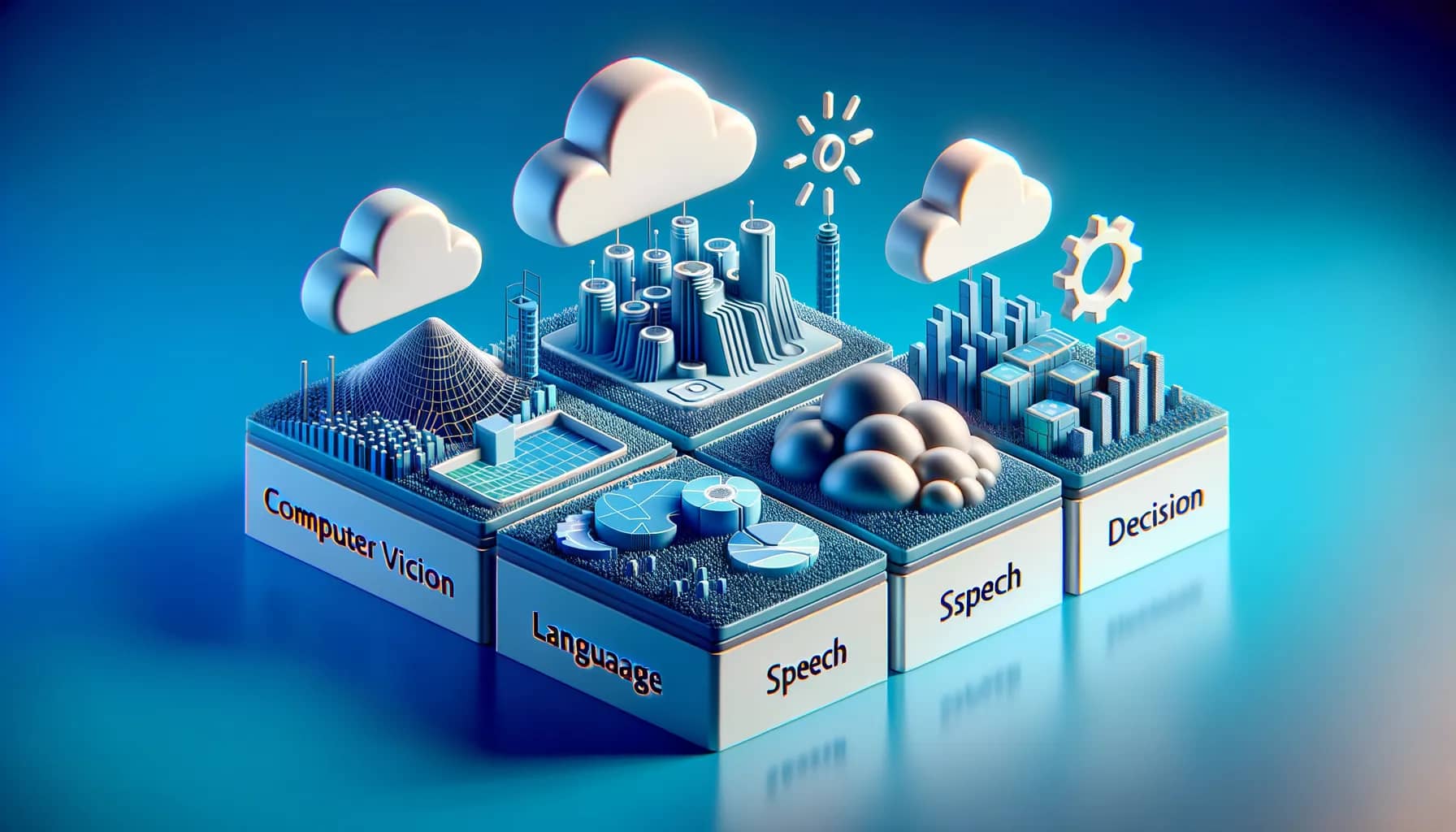
Enterprise Azure AI Solutions
Last updated by Errin O'Connor, Founder & Chief AI Architect, EPC Group
Transform your business with Azure AI. We offer a range of solutions, including:
- Azure OpenAI in Microsoft Foundry
- Custom Machine Learning models
- Foundry Tools
- AI governance
With experience in the Microsoft ecosystem since 1997, we deliver enterprise-grade AI solutions.
What a bounded Azure AI implementation fixes before the build
An Azure AI engagement should turn one business workflow into an evaluated system the client can run. Four decisions bound it, and each one depends on how Microsoft operates the service.
| Step | What is decided | Why it matters on Azure |
|---|---|---|
| 1. Scope the workflow | One workflow, its data sources and users, the model and version, and the deployment type | The deployment type sets where prompts are processed: Global can use any geography where the model is deployed, Data Zone stays within the zone, and stored data stays in the resource's geography |
| 2. Design controls and integration | Private endpoint, Microsoft Entra authentication, guardrail thresholds, the abuse-monitoring setting and the integration points | Prompts and completions are filtered in real time against configured thresholds; modified abuse monitoring needs Microsoft's approval |
| 3. Evaluate the system | A fixed test set from the client's own content and acceptance criteria set before the build | Microsoft advises evaluating models against your own application, prompts and data, comparing quality, latency and cost together rather than relying on public benchmarks |
| 4. Hand off operations | The next retirement date, a named migration owner, the upgrade setting and the alerting | Generally available models follow a standard 18-month lifecycle, retired models return 410 Gone, provisioned deployments are not auto-upgraded, and Microsoft gives at least 60 days' notice |
A demonstration is not a production deployment: the difference is steps 3 and 4. The sample implementation record (CSV) shows the twelve entries an engagement fills in. Its rows are synthetic examples, not client data.
Primary sources
- Foundry Models lifecycle and support policy — Microsoft Learn, updated 2026-07-24
- Model retirement schedule — Microsoft Learn, updated 2026-09-21
- Data, privacy, and security for Foundry Models sold by Azure — Microsoft Learn, updated 2026-05-18
- What are Foundry Tools? — Microsoft Learn
Comprehensive Azure AI Solutions
From OpenAI to Machine Learning—we cover the full Azure AI ecosystem.
Azure OpenAI Service
Enterprise deployments of current Azure OpenAI models (the GPT-5 family, GPT-4.1, reasoning and image models) with private endpoints and compliance controls.
Azure Machine Learning
Custom ML model training, deployment, and MLOps with Azure Machine Learning studio.
Foundry Tools
Prebuilt and customizable APIs for vision, speech, language and documents, the services many teams still call Cognitive Services.
AI Governance & Compliance
Enterprise AI governance frameworks ensuring responsible AI, security, and regulatory compliance.
AI Workflow Automation
Integrate AI into business processes with Azure Logic Apps, Power Automate, and custom solutions.
AI Monitoring & Observability
Real-time AI model monitoring, performance tracking, and automated alerting.
Proven Azure AI Implementation Approach
Assess
Evaluate AI readiness, identify use cases, data quality assessment, and compliance requirements analysis.
Design
AI architecture design, model selection, governance framework, and security baseline establishment.
Deploy
Model training, testing, deployment to production endpoints, and integration with existing systems.
Monitor
Continuous monitoring, performance optimization, bias detection, and cost management.
Compliance-First Azure AI Solutions
Industry-specific AI architectures with built-in compliance.
Healthcare
HIPAA-compliant AI for diagnostics, patient risk prediction, and clinical decision support with full compliance.
Financial Services
Fraud detection, risk modeling, and algorithmic trading with SOC 2 compliance. We map AI workloads to SOC 2 Trust Service Criteria (Security, Availability, Confidentiality) and produce evidence packages for annual SOC 2 audits.
Government
FedRAMP AI solutions for federal, state, and local government with secure deployments. Azure Government Cloud holds FedRAMP High authorization, Azure OpenAI Service is available in Azure Government for FedRAMP workloads, and IL4/IL5 workloads are supported with appropriate controls.
Manufacturing
Predictive maintenance, quality control, and supply chain optimization with Azure IoT + AI.
Your Azure AI Partner for Enterprise Success
Gold Partner experience with deep Azure AI knowledge
Enterprise-grade AI implementations
Across HIPAA, SOC 2, FedRAMP, and CMMC engagements to date
Business-hours (Central) support with requests accepted around the clock
Frequently Asked Questions
Common questions about our Azure AI consulting services
What is Azure OpenAI Service and how is it different from ChatGPT?
Azure OpenAI is OpenAI's models hosted by Microsoft in Azure, now part of Microsoft Foundry. Microsoft states that prompts, completions, embeddings and training data are not available to OpenAI, are not used to train foundation models without your permission, and that the models do not interact with services OpenAI operates, such as ChatGPT. Processing location depends on the deployment type: prompts stay in the geography you choose unless you use a Global or Data Zone deployment, which can process them in any geography where the model is deployed or anywhere in the data zone, while stored data stays in your geography (Microsoft Learn, Data, privacy, and security for Foundry Models sold by Azure, updated 2026-05-18). It adds private endpoints, Microsoft Entra authentication and Azure policy controls that consumer ChatGPT does not.
Is Azure AI HIPAA compliant for healthcare applications?
Yes. Azure AI services can be configured for HIPAA compliance with Business Associate Agreements (BAA), encrypted data at rest/in transit, private endpoints, audit logs with 6-year retention, and PHI protection controls. We implement Azure AI with HIPAA-compliant architectures including Azure Key Vault, managed identities, and Azure Policy governance.
How much does Azure OpenAI Service cost?
Azure OpenAI is billed per token, and the rate depends on the model and on the deployment type: Global, Data Zone or regional Standard, Batch, or provisioned throughput. Microsoft's current model schedule lists the GPT-5 family, GPT-4.1, GPT-4o, o-series reasoning models and gpt-image models (Microsoft Learn, Model retirement schedule, updated 2026-09-21), so price the model and deployment type you will actually run on Microsoft's Azure OpenAI pricing page. We help optimize costs through prompt design, caching, and right-sizing model selection. Azure AI workloads also have predictable and variable cost components, and we apply FinOps controls to both: Azure Reservations (1-year or 3-year) for predictable GPU and compute VM workloads, Azure Savings Plans to extend compute discounts across instance families, and Azure Hybrid Benefit for BYOL Windows Server and SQL Server licenses.
Can you fine-tune an Azure OpenAI model on our proprietary data?
Yes, on the models Microsoft supports for it. Microsoft's fine-tuned model schedule lists gpt-4.1, gpt-4.1-mini, gpt-4.1-nano, gpt-4o, gpt-4o-mini and o4-mini, each with separate training and deployment retirement dates (Microsoft Learn, updated 2026-09-21). We handle data preparation, fine-tuning job execution, model evaluation, and deployment. Microsoft states that a fine-tuned model is available only to the customer whose data created it and that training data is not used to train foundation models without permission.
What AI governance framework do you recommend?
We implement a 7-pillar AI governance framework: (1) Model Risk Management, (2) Responsible AI principles (fairness, transparency, accountability), (3) Data governance, (4) Security & privacy controls, (5) Bias detection & mitigation, (6) Explainable AI, and (7) Continuous monitoring. This aligns with NIST AI Risk Management Framework and industry best practices. In practice this means risk classification, model cards, and audit trails for every AI model; content remediation, sensitivity labeling, and Purview integration before AI deployment; private endpoints, CMK encryption, DLP for AI outputs, and role-based access; automated fairness testing on model outputs using Azure Responsible AI tooling; human-readable explanations for AI decisions using Azure InterpretML and the Responsible AI dashboard; and model drift detection, performance dashboards, and incident response alerts.
How long does an Azure AI implementation take?
Timelines vary by complexity: Azure OpenAI proof-of-concept (2-4 weeks), production chatbot (8-12 weeks), custom ML model (12-20 weeks), full AI platform with governance (6-12 months). We use agile sprints to deliver incremental value, with initial POCs often deployed in under 30 days.
What is the difference between Azure AI and Azure OpenAI?
Azure OpenAI covers OpenAI's models hosted in Azure, today the GPT-5 family, GPT-4.1, GPT-4o, o-series reasoning, audio and gpt-image models. Microsoft Foundry is the wider platform: it hosts Azure OpenAI alongside models from other providers, and Foundry Tools add Speech, Translator, Language, Document Intelligence, Vision, Content Safety and Azure AI Search. Language Understanding (LUIS), QnA Maker and Content Moderator are listed as retired. Azure Machine Learning remains the service for training and operating custom models.
What is Azure Confidential Computing?
Azure Confidential Computing uses hardware-based trusted execution environments (AMD SEV-SNP or Intel TDX enclaves) to protect data while it is being processed — data in use, not just at rest and in transit. Even the Azure host operator cannot access data within the enclave. It is the right choice for regulated workloads that require cryptographic proof of data isolation: clinical analytics on PHI running on shared Azure infrastructure, financial services M&A modeling with confidential deal data, and federal IL5 workloads requiring hardware-attested isolation. Supported on DCadsv5 and ECasv5 series VMs in Azure.
How much does Azure AI consulting cost?
Each engagement is quoted as a fixed fee after a scoping call. The AI Readiness Assessment, an Azure OpenAI deployment (single use case, governance included, 8-12 weeks) and AI Governance Implementation are each sized to the tenant and the use case rather than sold by the hour. Ongoing managed services include monitoring, retraining triggers, and quarterly compliance reviews.
Ready to Transform Your Business with Azure AI?
Get a free Azure AI consultation. We'll discuss your AI strategy, compliance requirements, and ROI projections.
Related Resources
Azure migration consulting: how to choose (2026)
What an Azure migration consultant should cover — the six-phase method, six evaluation criteria and FinOps maturity — and the firms buyers shortlist.
Azure OpenAI Enterprise Deployment Guide
Architecture-to-production guide for Azure OpenAI: model selection, RAG, responsible AI guardrails, and cost optimization.
Microsoft Copilot Studio Enterprise Guide
Build custom AI agents with Copilot Studio: low-code bot development, knowledge bases, and compliance controls.
Microsoft Copilot ROI Calculator
Calculate enterprise AI ROI with our detailed break-even analysis framework for Microsoft Copilot deployments.
Get a Free Consultation
Fill out the form below and our team will get back to you within 24 hours.
Deep-Dive Guides
Related enterprise references from the EPC Group knowledge base:
Documented and anonymized engagements
Named engagements come first; anonymized summaries follow under the anonymized-engagement rule — the client is not named and every statement is EPC-reported. Documents behind named engagements are in the Evidence Center.
- Azure Data Warehouse and Power BI: Medical Devices (2025)Anonymized engagement summary · Medical device manufacturer · 2025
- Backup Servers to Azure: Title and Settlement ServicesAnonymized engagement summary · National title and settlement services company · 2021
- Azure Cloud Migration: Global ManufacturerAnonymized engagement summary · Manufacturing
Related reading
- Azure Notification Hubs: Pricing and Features of a Scalable Mobile Push Engine
- Azure Percept Pricing & Features
- Azure Web PubSub Pricing and Features: Real-Time Messaging
- Azure AI Services: Enterprise Guide to Cognitive APIs
- Azure Kubernetes Service (AKS) Enterprise 2026
- Azure OpenAI Service vs OpenAI API Enterprise (2026)
- What does a governed Azure OpenAI deployment look like for an enterprise?
- Can a healthcare organization use Copilot or Azure OpenAI chatbots under HIPAA?
- Azure AI Search Enterprise RAG (2026)
- Azure Landing Zone Cost + Deployment Guide (2026)